Skip to content



- Bitcoin falls despite a weaker dollar as fear-driven flows move toward gold.
- U.S. spot demand remains weak, with Coinbase Premium Index staying negative.
- Bitcoin trades below its 21-week trend line, signaling an ongoing corrective phase.
Bitcoin traded near $87,913 after a weak week. The U.S. Dollar Index fell to 97.26, down 0.35% in 24 hours. Past cycles saw Bitcoin rise during such drops, but this move brought no support. Analysts noted that the current decline reflects fear, not growth or easier liquidity.
CryptoQuant highlighted that the dollar slipped due to market anxiety. Gold attracted inflows, while Bitcoin ETFs recorded heavy outflows. This shift showed a preference for safety instead of risk. Analysts added that stress in foreign-exchange markets amplified this reaction.
They pointed to discussions about potential yen-support operations as one driver. When stress rises, investors cut exposure to risk assets. Bitcoin then trades more like equities than a store of value. The correlation shifts because fear, not liquidity, guides market behavior.
Dollar Breakdown No Longer Supports Bitcoin’s Trend
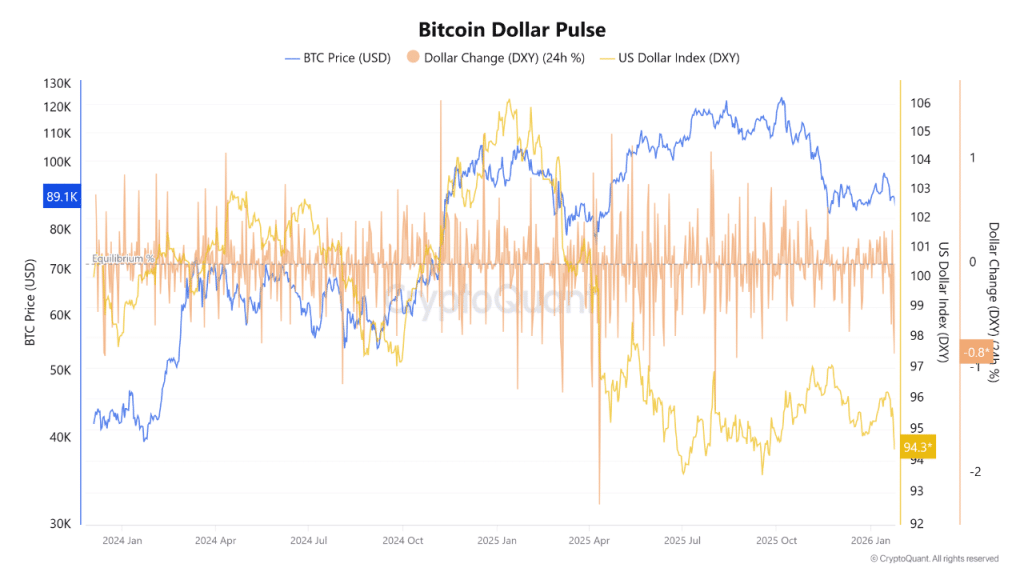
CryptoQuant shared the Bitcoin Dollar Pulse chart to highlight the pattern. Bitcoin climbed above $100,000 and later neared $120,000 in 2024 and early 2025 while the dollar stayed near or above 100. Stable conditions offered a supportive backdrop.
Source: CryptoQuant
This cycle is different. As the dollar broke down, Bitcoin also fell. Analysts stressed that a weak dollar only helps Bitcoin when risk appetite improves. They said the current environment offers no such momentum.
Flows are now in favor of gold instead of crypto. Investors are choosing to be safe rather than taking risks. Analysts say the dollar’s movement is background noise, and Bitcoin has no bullish pressure.
Also Read: Bitcoin Gains Ground as Las Vegas Merchants Accept Crypto
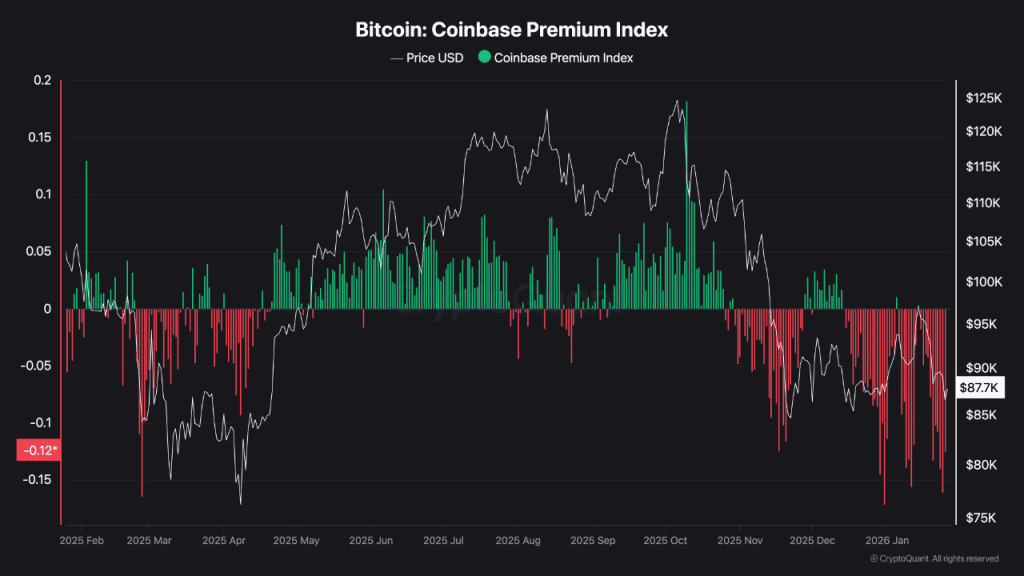
Coinbase Premium Index is still well below zero. Bitcoin is trading at a discount on Coinbase compared to offshore exchanges. This is a clear indication that selling out of U.S. spot flows is still ongoing, as well as a lack of institutional interest.
Source: CryptoQuant
Weak Demand and Trend Signals Drive Bitcoin Correction
Short rebounds have not closed the gap. Analysts observed that negative readings in past cycles were an indication of weak accumulation. This, they said, is still true today. Until there is a positive move in the index, futures are driving short-term action.
Demand in the US is still lacking. Analysts view this as a major barrier to the market’s development. Spot market participation has not been strong.
Matrixport highlighted another pressure point. Bitcoin sits below its 21-week moving average, which is near $96,000. This trend line has defined major phases across several years.
Price broke below this level in late 2025. Attempts to reclaim it later failed. Analysts said this failure keeps Bitcoin in a corrective stage.
Matrixport outlined a broad range ahead. The upper zone sits near $121,000. The lower boundary remains close to the $70,000 region if stress persists.
Also Read: Crypto Exchange WhiteBit Declared Undesirable by Russia Over Alleged Ukraine Funding