Skip to content


- Bitcoin’s price drop mirrors broader market trends, with investor risk aversion driving volatility.
- Despite recent decline, Bitcoin remains over double last year’s price, reflecting market growth.
- Volatility of tech stocks like Tesla and AMD surpasses Bitcoin, challenging common perceptions.
Binance CEO Richard Teng has stated that Bitcoin’s recent price drop reflects broader market trends. He explained that Bitcoin’s volatility is not out of line with other major asset classes. During a media roundtable in Sydney, Teng said that volatility is common across all asset types. He attributed Bitcoin’s recent decline to investors reducing leverage and adopting a more risk-averse stance.
Bitcoin was trading at slightly more than $84,000, or 33% less than it had been on October 6, an all-time high. The overall cryptocurrency market capitalization has also plummeted by 8.37%, reaching its highest point of $4.28 trillion but now being valued at only $1.67 trillion.
Bitcoin’s Price Still Higher Than Last Year Despite Recent Decline
Although the price has fallen, Bitcoin is still priced higher than it was last year. Teng said the recent decline was not excessive after such high growth in the crypto market in the last 1.5 years.
The remarks of Teng contradict the widely stated belief that Bitcoin is more volatile than the traditional assets. The BitBo data also notes that the 60-day volatility of Bitcoin in 2025 was 1% to 2.44%.
Also Read: Bitcoin Faces Downward Pressure Amid Recent Price Drop
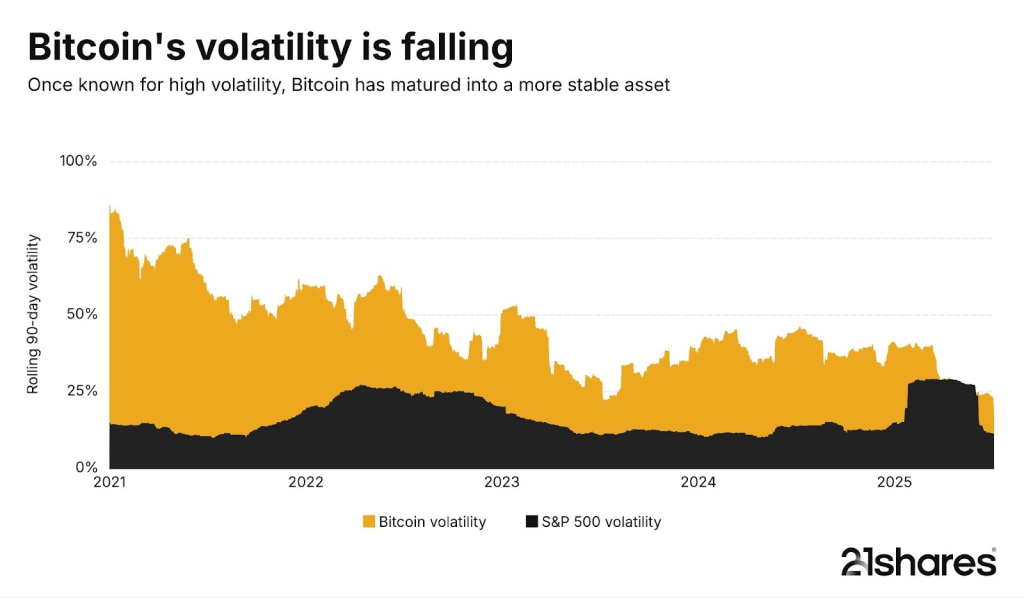
This volatility can be compared to other major assets. Historically, Bitcoin volatility was significantly greater, with an annualized volatility of 181% in 2013. Nevertheless, the 21Shares report recently reveals a gradual drop, where the volatility of Bitcoin has decreased to 23% in 2023.
Source: 21Shares
This reduction in volatility notwithstanding, price fluctuations in Bitcoin are still more unpredictable compared to the traditional assets, such as the S&P 500. According to V-Lab, the volatility of Bitcoin is more than 50% a year, and that of the S&P 500 is slightly more than 15% a year.
Tech Stocks Like Tesla and AMD Show Higher Volatility Than Bitcoin
Nonetheless, even more volatile than Bitcoin have been some tech stocks, including Tesla and AMD. The volatility of Tesla annually is more than 65%, and that of AMD is more than 73%. These instances indicate that BTC is not as volatile as many people may believe.
Teng noted that crypto has performed well over the past 1.5 years, and thus there is no surprise that investors are cashing in. Although the recent fall is significant, it is a natural cyclical movement in the market. The adoption and liquidity of BTC are on the rise, and this will likely lead to consistency in the future price fluctuations.
The words of Teng underscore the changing roles of BTC in the financial markets. Its volatility is still high, but its price movement is moving more towards conventional assets as it continues to become widely accepted.
Also Read: FG Nexus Shifts Strategy, Sells Ethereum for Share Buybacks