Skip to content


- Arthur Hayes backs Trump’s tariffs as bullish for Bitcoin, citing macro instability and capital flight as catalysts for BTC gains.
- Bitcoin price rises to $84.5K amid market volatility, as the Nasdaq 100 sees its worst point drop since 2020.
- Hayes predicts Fed rate cuts and QE, which could further fuel Bitcoin’s surge as liquidity returns to risk-on assets.
BitMEX co-founder Arthur Hayes believes the Trump administration’s aggressive new tariffs could cause global economic disruption but also serve as a bullish catalyst for Bitcoin.
In an April 3 post on X (formerly Twitter), Hayes reacted to the latest trade policy shake-up announced by the U.S. government. He acknowledged the potential global pain caused by the tariffs but emphasized that such macro instability often benefits alternative assets like Bitcoin (BTC).
“Global imbalances will be corrected, and the pain papered over with printed money, which is good for BTC,” Hayes wrote.
“Some of y’all are running scurred, but I LOVE TARIFFS,” he added defiantly.
The tariff announcement marks a significant shift in U.S. trade policy. Beginning April 5, a blanket 10% tariff will be applied to all countries exporting to the United States. Key global economies face even higher rates China at 34%, the European Union at 20%, and Japan at 24%.
Hayes suggests that these tariffs could trigger broader economic imbalances, particularly in global currency markets and U.S. equities. These shifts, in turn, could drive investor interest in Bitcoin as a hedge against traditional market volatility and fiat currency risk.
Bitcoin Price Climbs Amid Macro Volatility
At the time of writing, Bitcoin is trading at $84,500, showing a 0.21% decrease over the past 24 hours. The cryptocurrency has a 24-hour trading volume of $45.94 billion and a total market capitalization of $1.68 trillion.

While the move may appear modest, Hayes believes it’s a sign of what’s to come. He points to the weakening of the U.S. Dollar Index (DXY) as a direct consequence of capital outflows from U.S. equities. Foreign investors are increasingly selling off U.S. assets and repatriating funds, weakening the dollar and creating tailwinds for alternative stores of value like BTC and gold.
On April 3, the Nasdaq 100 suffered its worst single-day point loss in history, shedding over 1,060 points. According to market analysis from The Kobeissi Letter, the index came within 1.5% of triggering a circuit breaker, something not seen since the COVID crash in March 2020.
“This is good for BTC and gold over the medium term,” Hayes commented.
Hayes also spotlighted the potential impact of tariffs on China’s economy, especially the Chinese yuan (CNY). He warned that the steep 34% tariff on Chinese exports may lead Beijing to devalue its currency in response.
“With a 65% effective tariff levied, China could respond by allowing CNY to weaken past 8.00,” he noted.
A weaker yuan may incentivize Chinese investors to move capital into decentralized assets like Bitcoin in an attempt to preserve wealth amid inflationary pressures and economic uncertainty.
Arthur Hayes Sees Bitcoin Surge on QE
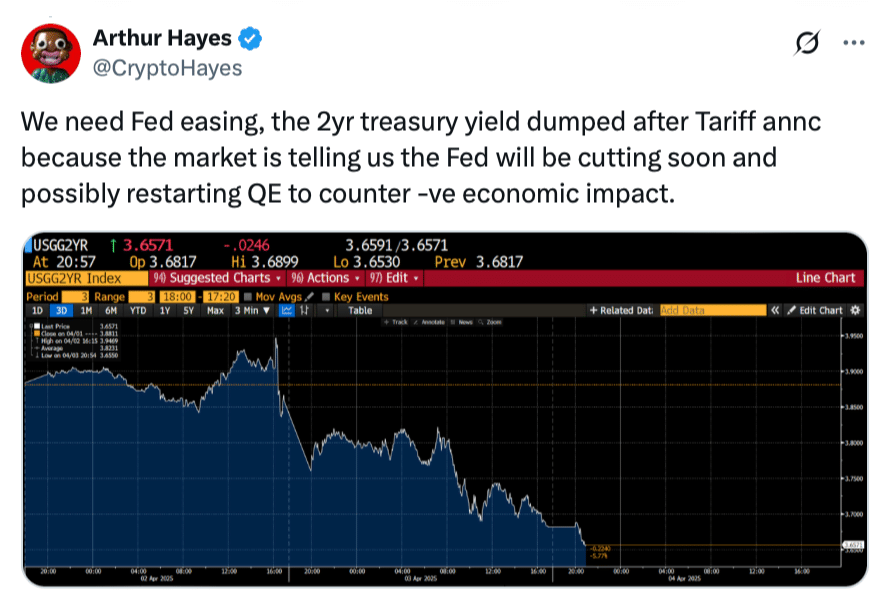
Another key factor Hayes mentioned is the likely response from the Federal Reserve. He pointed to a sharp drop in the two-year U.S. Treasury yield following the tariff announcement as a sign that markets are now pricing in rate cuts and possibly a return to quantitative easing (QE).
“We need Fed easing,” Hayes said, implying that liquidity injections from the Fed would provide yet another boost to risk-on assets such as cryptocurrencies.
Historically, rate cuts and QE have increased market liquidity, encouraging investors to allocate capital into assets like Bitcoin that offer fixed supply and long-term upside potential.
Hayes isn’t the only one anticipating a positive outcome for Bitcoin amid economic turbulence. Jeff Park, head of alpha strategies at Bitwise Asset Management, has been bullish on BTC in a tariff-heavy environment since early February.
“In a world of weaker dollar and weaker US rates… risk assets in the US will fly through the roof beyond your wildest imagination,” Park said in a Feb. 3 post.
“Bookmark this and revisit as the financial war unravels, sending Bitcoin violently higher.”
Related | FDUSD Depegging Controversy Sparks Legal Threats and Stability Concerns