Skip to content



- The CCT standard allows stablecoins and tokens to move across blockchains with zero slippage.
- Developers gain full control through self-serve deployment and flexible customization.
- Chainlink CCIP provides defense-in-depth security for cross-chain token transfers.
According to the blog, $1 should always equal $1, regardless of the app, platform, or blockchain. This principle drives the development of Cross-Chain Tokens (CCTs), powered by Chainlink’s Cross-Chain Interoperability Protocol (CCIP), which allow stablecoins and other ERC20-compatible tokens to move seamlessly between blockchains.
Made possible with Chainlink’s Cross-Chain Interoperability Protocol (CCIP), CCTs allow for zero-slippage transfer and full interoperability across networks. Blockchain systems have introduced fragmented liquidity and complicated development workflows.
Each chain traditionally required manual integration, consuming time and energy. CCT changes this model. It provides one self-serve interface with which developers may implement token pools between chains in minutes with reduced friction and with security intact.
Reducing the necessity for dependency on liquidity pools and in favor of using burn-and-mint or lock-and-mint techniques, the CCT standard ensures that tokens transfer stably, efficiently, and securely.
Chainlink Programmable Transfers Unlock New Use Cases
CCTs give the developers complete control over their interactions with cross-chain tokens. Token pool and token contract ownership are retained with the developers, and vendor lock-in is avoided. They are also capable of setting up rate limiting, incorporating programming logic for transferable programming, and even defining custom rules for implementation using CCIP.
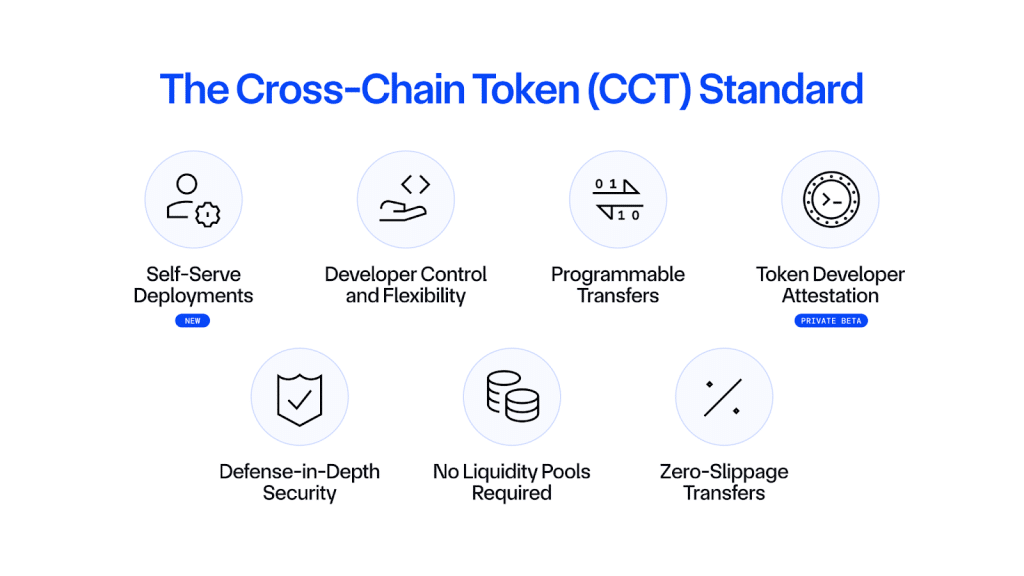
Programmable transfers open up new possibilities. Tokens can be sent across chains and call functions like staking, collateralizing, or releasing assets, all as one atomic instruction. It makes it convenient for multi-chain workflows, particularly for decentralized finance (DeFi) protocols that are deployed across multiple blockchains.
CCTs are also logic-agnostic with regard to tokens. Developers either use pre-audited token pool contracts or execute non-critical application-specific contracts. It is thus seamless for projects to scale without inheriting code specific to the CCIP and yet benefiting from the value of Chainlink’s infrastructure.
Strengthening Compliance for Stablecoins and RWAs
Security is the CCT system’s foundation. Decentralized oracle networks validate transfers, and an autonomous risk management system monitors transactions in real time. The same system has processed trillions of dollars of onchain value since 2022.
Token creators can also secure their tokens with third-party verifiers. Third-party verifiers will confirm token events such as locks or burns before tokens are sent on destination chains. This is one of the mechanisms that supports compliance and trust, particularly for stablecoins, wrapped Bitcoin, or tokenized physical assets.
Several major protocols have already incorporated the CCT standard. Aave adopted it for the GHO stablecoin, and other tokens such as Solv Protocol, Lombard, Tensorplex, and Shiba Inu’s ecosystem tokens have followed suit.
With self-serve onboarding, control-as-code, and security-focused architecture, CCTs are a big step up for interoperability in the blockchain space. They simplify the dev experience while upholding the core rule of stable value: one dollar is one dollar no matter what the chain.
Related Reading: Metaplanet Expands Into U.S. and Japan as Bitcoin Holdings Hit $2.3 Billion