Skip to content


- Yemeni citizens are turning to decentralized finance (DeFi) due to sanctions and failing banks.
- U.S. sanctions target Houthi-linked crypto activity funding conflict and evading restrictions.
- DeFi platforms now handle most of the crypto-related internet traffic in Yemen.
In the heart of a fractured Yemen, ordinary people are turning to new tools to survive. With banks shut down and traditional financial services often out of reach, decentralized finance (DeFi) has become a lifeline for many.
The recent U.S. sanctions against the Houthis have further exacerbated economic instability within Houthi-held territories. In response, everyday Yemenis are evading banks and utilizing DeFi protocols for moving as well as storing their funds.
Decentralized finance enables money to be sent, received, and stored by users independent of banks as well as intermediaries. This autonomy is critical as additional banks are coming under restrictions. Since the U.S. listed the Houthis as a Foreign Terrorist Organization, a number of Yemeni banks and other finance entities have had their names included on sanction lists.
Individuals are now turning to sites that are still accessible, even with such circumstances. DeFi sites are one of the most widely used sites in Yemen as of today. They enable cross-border remittances as well as payments, immensely helping family members receiving assistance from foreign relatives. The digital tools enable faster payments with fewer costs as well as risks than through physical banks, whose money might not be available or whose locations of operation might be closed.
DeFi as a Strategic Tool for the Houthis
Whereas civilians venture into DeFi for need, the Houthis have employed their cryptocurrency for strategic purposes. Since sanctions became stricter, the group adopted digital currencies as a means of funding activities as well as acquiring military equipment.
US officials have traced Houthi-backed crypto accounts that have made hundreds of millions of dollars worth of transactions, connecting them with both Iranian and Russian actors. It bought drones, as well as anti-drone equipment, with the money sent through sanctioned intermediaries.
The US Treasury sanctions also targeted individuals working directly under Sa’id al-Jamal, a financier who is known to finance the Houthis as well as Iran’s IRGC-QF. Investigators identified big outflows of the cryptocurrencies from the accounts of the Houthis through analysis of the blockchain.
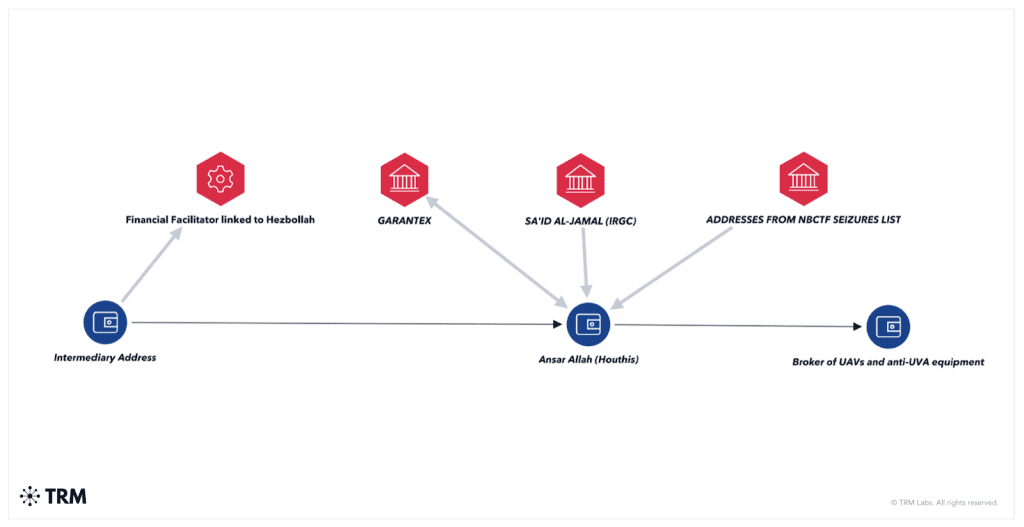
These even culminated with some of them ending up on inactive Russian sites or addresses of other sanctioned organizations such as Hezbollah. The activities of the group in the digital sphere only have a minimal scope as opposed to other international groups.
Crypto in Conflict Yemen’s Digital Escape
Yemeni internet infrastructure is weak, and there is low digital literacy across much of the country. But need drives individuals increasingly toward alternatives such as DeFi. Local exchanges are not common, though several money service companies provide crypto opportunities. There have even been transaction booms for some exchanges as a consequence of U.S. policy directives impacting the Houthis.

For many regular people, engaging in DeFi is not investing. It is surviving. It is getting by so that you can afford milk, send money home, or avoid the unforgiving restrictions of one of the most inaccessible banking systems in the world. bling under war and sanctions.