Skip to content



- Ethereum rollups face a warning from Vitalik Buterin: advancing to stage 2 without strong proof systems may reduce security rather than improve it.
- Rollups with incomplete or unreliable fraud/validity proofs may be less secure than earlier-stage multisig setups.
- Buterin suggests using multiple proof systems in tandem and urges the community to prioritize resilient cryptography over stage labels.
As Ethereum’s scaling roadmap progresses, a chorus of voices across the ecosystem has begun pushing for the next major milestone: stage 2 rollups. These are rollups that are not only decentralized but also feature fully trustless fraud or validity proofs. But Ethereum co-founder Vitalik Buterin is urging caution—highlighting that more decentralization on paper doesn’t always equal more security in practice.
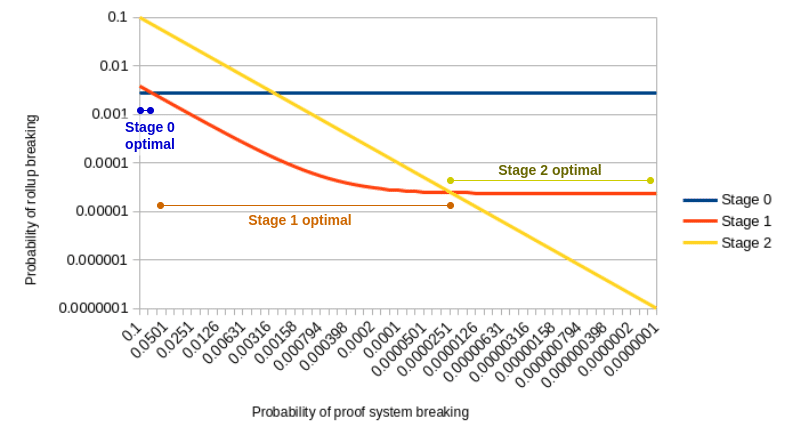
In a recent post, Buterin shared a condensed mathematical model demonstrating that rushing to stage 2 without a robust, resilient proof system could make things worse, not better. His warning cuts through the excitement surrounding “stage 2 readiness,” a badge many rollups are eager to claim.
“Buterin’s core point is subtle but critical: the security of a rollup doesn’t magically increase just because it hits ‘stage 2.’ It depends on the actual reliability of the underlying cryptographic proofs.”
According to his analysis, each member of a rollup’s security council has a 10% chance of independent failure. Safety and liveness failures are equally likely. Traditional multisig governance at earlier stages (stage 0’s 4-of-7 or stage 1’s 6-of-8 multisigs) can outperform a weakly decentralized or incomplete stage 2 implementation in real-world security
Stage 2 Risks for Ethereum Rollups and Decentralization
The takeaway is that if your proof system is anything less than airtight, it becomes a liability. This is especially true if it breaks more than once in 100,000 cases (failure rate above 10⁵), making stage 2 a hindrance rather than a safeguard. Combining a centralized or incomplete proof system with a weakened security council can amplify risks instead of reducing them.
Buterin also acknowledges real-world constraints that models can’t always capture. Shared infrastructure, legal pressure, or even collusion risks can make multisig-based governance more fragile than theory suggests. “In practice, people often fail together, not independently,” he noted.
As a stopgap, Buterin proposes using multiple proof systems in tandem—a kind of proof-system multisig—until the technology matures. And crucially, he argues that the community should look beyond roll-up classification checklists.
“Security isn’t a badge; it’s a continuum,” he wrote. “True safety comes from the interplay between sound governance and resilient cryptography, not from simply checking the ‘stage 2’ box.”
He also encouraged ecosystem tools like L2Beat to track not only decentralization and upgradeability but also the maturity of proof systems and their audits. These should be viewed as essential parts of the broader decentralization narrative.
As the Ethereum ecosystem marches toward its rollup-centric future, Buterin’s message serves as a timely reminder. Decentralization is not a destination; it’s a process, and rushing to the next milestone without securing the path may lead to more harm than good.
Related | Nasdaq listing boosts Galaxy Digital’s push into the US crypto market