Skip to content



- Ripple’s legal chief, Stuart Alderoty, criticized the SEC’s approach to crypto regulation, urging clearer rules to distinguish digital assets from securities.
- Ripple pointed to a 2023 ruling that XRP is not a security when traded on secondary markets, arguing this should guide broader regulatory treatment.
- Ripple urged the SEC to adopt a more practical framework based on a token’s decentralization, market maturity, and lack of ongoing obligations to original buyers.
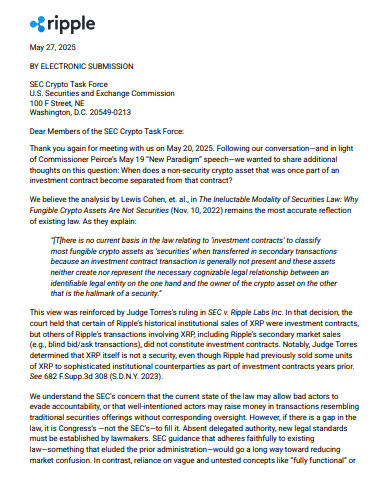
Ripple’s Chief Legal Officer, Stuart Alderoty, has reignited the conversation around cryptocurrency regulation by sending a fresh letter to the U.S. Securities and Exchange Commission’s (SEC) Crypto Task Force. The letter, shared publicly today on X (formerly Twitter), is Ripple’s formal response to a recent keynote speech delivered by SEC Commissioner Hester Peirce, titled “New Paradigm.”
Peirce’s speech posed a critical question at the heart of crypto regulation: When does a cryptocurrency stop being classified as an investment contract and thus a security and become simply a digital asset? This question strikes at the foundation of ongoing legal battles and regulatory debates that could shape the future of the crypto industry.
In the letter, Ripple expressed appreciation for the SEC’s openness in meeting with them on May 20, 2025, and took the opportunity to offer more detailed insights on this complex issue. The company emphasized its stance that the majority of cryptocurrencies traded on exchanges today do not qualify as securities. Drawing on authoritative legal opinions, including those of Lewis Cohen and other experts, Ripple highlighted that tokens sold on secondary markets typically fall outside the traditional scope of securities laws.
Ripple Demands Clear Crypto Laws After SEC Ruling
Ripple also addressed a landmark court ruling from last year by Judge Torres in the SEC’s ongoing lawsuit against Ripple. The ruling notably found that while some of Ripple’s initial sales of XRP to large investors could be classified as investment contracts, the XRP token itself is not a security when sold on secondary markets. This distinction, Ripple argues, is a crucial precedent for how digital assets should be viewed legally.
While acknowledging the SEC’s concerns about fraudulent activities and bad actors exploiting the crypto market, Ripple stressed that it is ultimately Congress’s responsibility, not the SEC’s alone, to update and clarify the laws governing digital assets. Ripple cautioned against the use of ambiguous regulatory criteria such as whether a token is “fully functional” or “sufficiently decentralized,” warning that such subjective tests create uncertainty and confusion in the marketplace.
Ripple proposed a clearer and more practical framework, emphasizing transparency. Their key points include that crypto tokens initially sold under investment contracts should be separated from those contracts once the issuer meets all obligations to the original buyers. Current token holders should have no ongoing legal claims against the issuer. Additionally, Ripple advocates for a “safe harbor” rule to shield honest crypto projects still developing from unnecessary legal risks as long as they follow established guidelines.
Ripple Urges SEC to Rethink Rules for Decentralized Tokens
Ripple suggested that the maturity of a crypto network measured by factors such as its market capitalization, longevity, and operational decentralization should be the primary criterion for whether a token remains regulated as a security. Tokens operating on large, open, permissionless networks without centralized control, which have existed for years, should no longer be subject to securities laws.
This letter marks another chapter in Ripple’s ongoing efforts to engage with regulators and advocate for balanced, practical crypto regulation. As the industry continues to evolve rapidly, Ripple’s legal team is pushing for clarity that can foster innovation while protecting investors.
The SEC’s next moves will be closely watched by the entire crypto ecosystem as market participants seek regulatory certainty that can help shape the future of digital finance.
Related | Bitcoin Investment Grows as Blockchain Group Raises €63.3M