Skip to content



- Latin American businesses increasingly use stablecoins for faster, cheaper cross-border payments.
- Traditional banking rails create hidden costs, delays, and capital lockups for companies.
- Stablecoin settlement reduces fees, speeds transfers, and frees working capital.
According to the blog, businesses across Latin America quietly changed how they move money internationally. Companies no longer accept slow and costly cross-border transfers. Financial teams now demand faster settlement and clearer costs. Stablecoins and other digital assets are emerging as alternatives to traditional systems. The SWIFT network powers most international wires.
It was designed decades ago for large institutional payments. It works for high-value transfers but struggles to support fintechs processing thousands of smaller transactions daily. A single wire includes multiple costs. Sending banks often charge $25–50. Receiving banks add $10–20.
Intermediary banks deduct further fees along the route. Foreign exchange spreads add 2–5% above the market rate, often invisible until funds arrive. Settlement delays of two to five business days keep millions of dollars in transit.
Stablecoin Rails Offer Lower Costs and Faster Settlement
Companies cannot use this money for operations or investment. Prefunded accounts in multiple countries add further capital costs. The total effect: transaction costs of 2–7% of value, delayed liquidity, and large amounts of idle capital. Stablecoins change the model.
Tokens pegged to fiat currencies move across blockchain networks like Polygon within seconds. Fees are low, and funds settle 24/7. Companies still pay on/off-ramp costs when converting between fiat and crypto. Yet, many traditional expenses disappear. Intermediary deductions vanish, foreign exchange friction reduces, and capital no longer sits idle in transit.
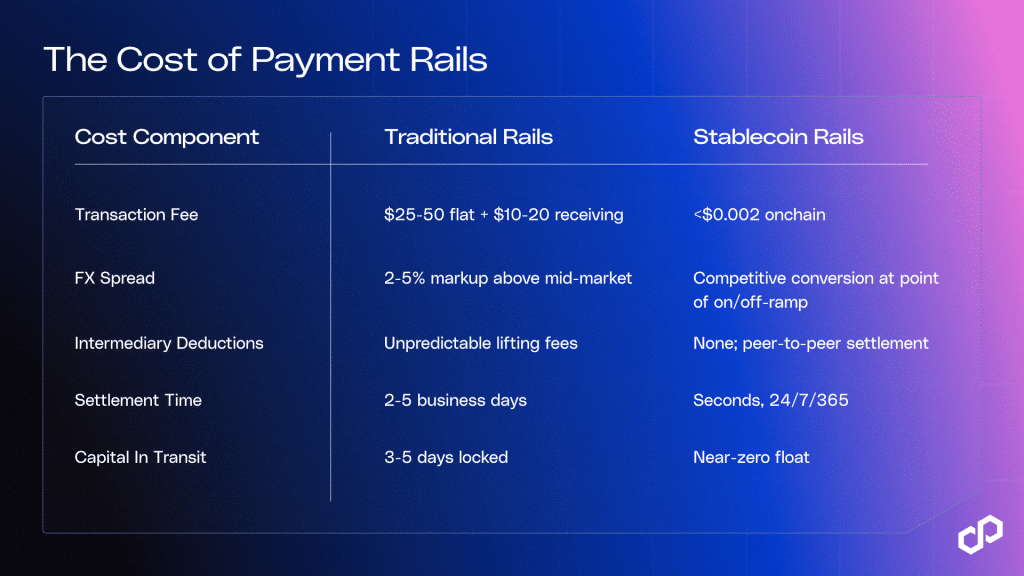
Funds move instantly, improving operational efficiency. Surveys show companies using stablecoins for B2B payments save 10–40% compared with traditional rails. Smaller firms report 10–20% savings, while larger institutions see larger reductions when all cost factors are included.
Financial Institutions Accelerate Adoption
Banks and fintechs in LATAM adopt stablecoins for clear operational benefits. Brazil leads the trend. Major banks issue local stablecoins and integrate USDC into platforms to speed cross-border flows. Remittance platforms also benefit, lowering costs for recipients while maintaining competitive margins. Payment service providers gain a unified settlement layer for multiple corridors.
They no longer need separate integrations for every national network. Corporate treasuries regain access to working capital previously locked in float. Dollar-denominated stablecoins can also earn interest, further optimizing treasury operations. Adoption grows quietly but steadily.
Institutions act on economics, not hype. Faster settlement, lower fees, and freed capital make stablecoins an increasingly attractive alternative to legacy rails. LATAM is proving the model works at scale, offering a blueprint for global cross-border payments.
Also Read: Strategy Becomes Most Shorted Large-Cap Stock as Bitcoin Slump Fuels Bearish Bets