Skip to content



- Stablecoins’ rapid growth raises financial stability risks globally, warns ECB.
- ECB highlights the imbalance with US dollar-denominated stablecoins outpacing euro alternatives.
- Global regulatory alignment is needed to address risks from cross-border stablecoin issuance.
The European Central Bank (ECB) has issued a warning about the risks posed by the rapid expansion of stablecoins. While still limited in the euro area, stablecoins are increasingly linked to global markets, raising concerns over financial stability. The market for stablecoins has surged, surpassing $280 billion, which accounts for 8% of the total cryptocurrency market.
Senne Aerts, Claudia Lambert, and Elisa Reinhold prepared the ECB report, Stablecoins on the Rise: Still Small in the Euro Area, But Spillover Risks Loom. It examines the vulnerabilities, use cases, and risks associated with stablecoins, which are growing fast despite their small presence in the euro area.
The report highlights that while the euro-denominated stablecoin market remains small, it is the rapid international growth and ties to traditional financial markets that are raising alarms.
Stablecoin Market Hits $280 Billion, Driven by US Dollar-Pegged Coins
The total market value of stablecoins amounts to more than $280 billion. Tether (USDT) and USDC are at the forefront with valuations of $184 billion and $75 billion, respectively. Comparatively, euro-pegged stablecoins are small, and only €395 million are circulating. Such a sharp imbalance indicates the power of the U.S. dollar with stablecoins.
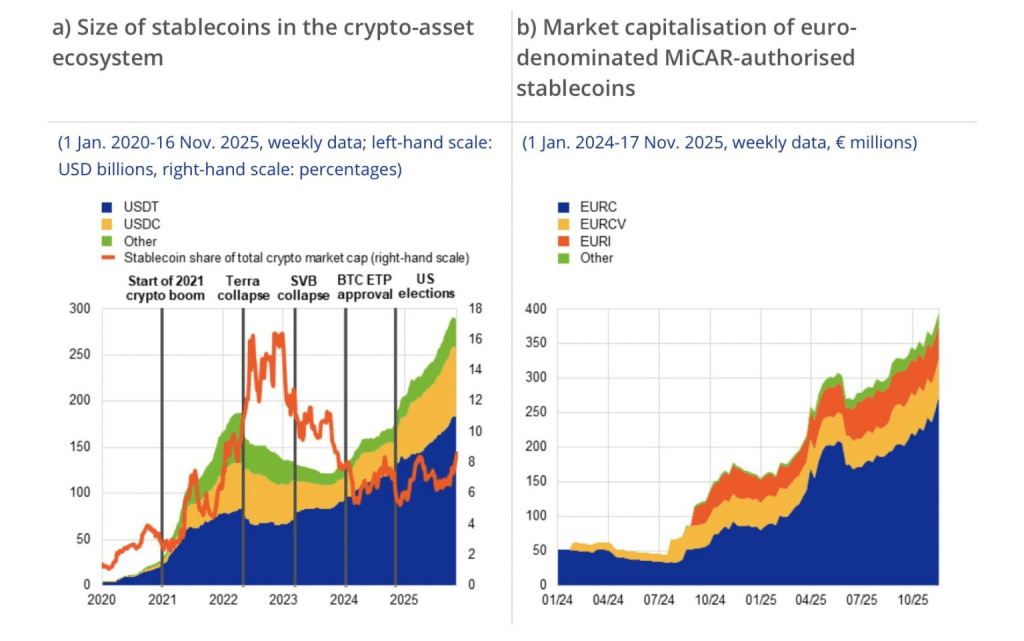
Source: ECB
The ECB puts the rise of stablecoins as a result of regulatory clarity, in particular the recent adoption by the EU of the Markets in Crypto-Assets Regulation (MiCA) and the GENIUS Act. Nonetheless, according to the ECB, most stablecoins find their use in the trade sphere. Approximately 80% of centralized crypto exchange platforms handle stablecoin transactions, and only 0.5% of their volume is attributed to real-world retail exchanges.
Also Read: Stablecoins’ Rapid Growth May Force ECB to Reevaluate Monetary Policies
The ECB cautions about structural weaknesses within the stablecoin market and the risks of de-pegging and redemption runs. Major stablecoins, such as Tether and USDC, are backed by system reserves of conventional financial instruments, such as US Treasury bills. The reserves directly couple coins with the world of financial markets.
ECB Urges Global Regulation to Mitigate Coin Risks
Tether and USDC are now some of the biggest holders of U.S. Treasuries and have portfolios as large as the largest money market funds in the world. Depending on the run on coins, U.S. Treasuries may be fire-sold in the global funding markets, thus disruption to the global financing markets.
According to the ECB, once coins keep expanding at their current rate, their market capitalization may be up to $2 trillion in 2028. This would increase the stakes, particularly since only two issuers are in possession of approximately 90% of the market. The report identifies the risk of cross-border regulatory arbitrage as well, so that EU-regulated issuers would currently be under-reserved.
The ECB requires global regulations in order to contain the risks of coins. Although the market is still small in the euro region, its fast development and connections to conventional financial markets must be closely monitored.
Also Read: Crypto Under Siege: Report Warns 20% of Companies Employ North Korean Operatives