Skip to content



- UNI jumps to $5.24 as UNIfication vote enters final phase and volume surges 135%.
- The proposal targets 100M UNI burn and activates fee switches on Uniswap v2 and v3.
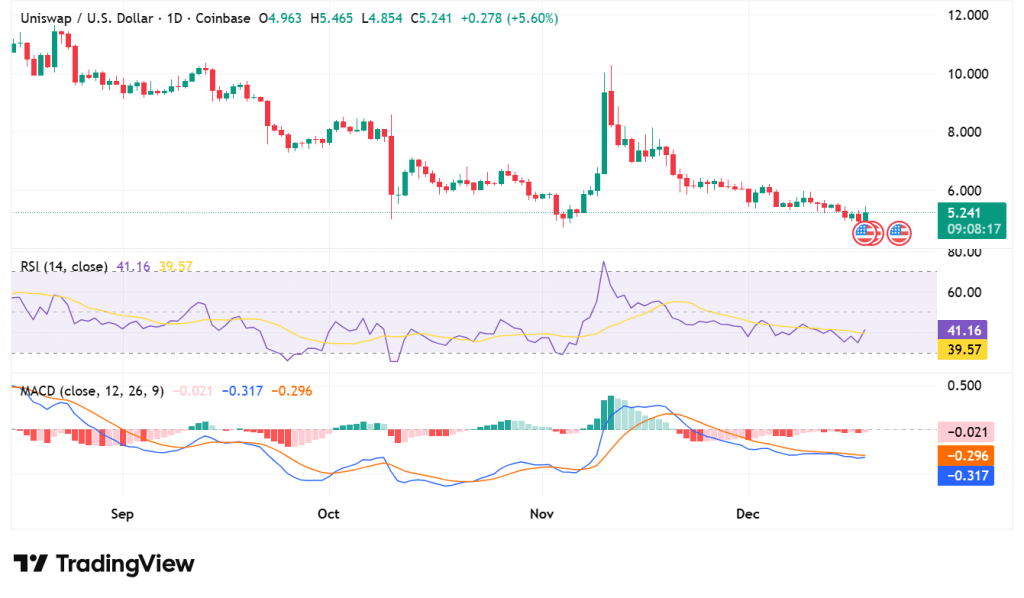
- The chart shows stabilization near $5 as momentum remains cautious but improving.
Uniswap’s UNI token climbed to $5.24 as markets reacted to a decisive governance update tied to supply and revenue mechanics. The token gained about 2.86% on the day, while trading volume surged 135.59% to $416.59 million. The move followed confirmation that Uniswap’s long-awaited UNIfication proposal has entered its final voting phase.
Uniswap founder Hayden Adams confirmed that voting will run from December 20 to December 25. The proposal calls for burning 100 million UNI from the protocol’s treasury. It also seeks to activate protocol fee switches on Uniswap v2 and v3. These changes have been debated for years within the community.
Uniswap Plans UNI Supply Reduction With Fee Burns
If approved, UNI’s circulating supply would fall from about 630 million tokens to roughly 530 million. This represents a sizable reduction relative to the current float. Such a supply cut would immediately change UNI’s scarcity profile. Markets often react strongly to structural supply shifts of this scale.
The proposal goes beyond a one-time burn. Protocol and Unichain fees would be routed into an ongoing burn mechanism. This would directly link Uniswap’s trading revenue to continuous UNI supply reduction. The change would alter how value accrues to token holders over time.
Over $4 trillion of lifetime trading volume has been conducted on swap. Nevertheless, despite such scale, UNI has largely been a pure governance asset. The suggested fee and burn arrangement alters that narrative. UNI is starting to be seen by traders as a token based on the performance of protocols.
Also Read: VivoPower Launches $300 Million Ripple Fund for Institutional Investors in South Korea
The steep increase in volume substantiates that reading. High turnover is an indication of active positioning and not thin liquidity movements. Participants in the market seem to be anticipating structural repricing in case the vote goes through.
UNI Holds Above $5 as Buyers Defend Support
On the day-to-day chart, UNI started at around $4.96 and rose to an intraday maximum of $5.46. The low of the session was at approximately $4.85 before buyers intervened, and UNI closed at approximately above $5.24, indicating a very high demand as of the recent lows. This price activity displays a stabilization following an extensive decline.
Short-term resistance is close to $5.50. There is more evidence of a strong resistance zone at around $6.00. An additional move above these levels on a daily basis would enhance positive momentum. On the negative side, support is strong at around $5.00. There exists a more substantial support zone at approximately $4.60.
RSI Stays Below Neutral as MACD Remains Bearish
Momentum indicators continue to be conservative. The Relative Strength Index is at 41.16. This reading is below the level of neutral 50. It reveals that momentum is weak and it is no longer oversold. The moving average of RSI is around 39.57, which proves the low selling pressure.
Source: TradingView
The MACD indicator is slightly bearish. The MACD line is at -0.317 and the signal line at -0.296. The histogram reads -0.021. The narrowing histogram indicates that downside momentum is dissipating, but there has been no positive crossover.
UNI demonstrates initial signs of stabilization. Volume has increased with price. Short-term orientation is now triggered by governance catalysts. The ultimate confirmation will depend on the outcome of the vote and the buyer’s follow-through.
Also Read: CME Group Broadens Crypto Derivatives Offering With XRP and Solana Futures