Skip to content



- The Swiss National Bank (SNB) rejected adding bitcoin to its reserves due to liquidity and volatility concerns.
- SNB still has indirect Bitcoin exposure through holdings in companies like Tesla and MARA Holdings.
- Bitcoin advocates argue the Swiss portfolio could have seen stronger growth with minimal additional risk.
At the 2025 General Assembly, Swiss National Bank President Martin Schlegel confirmed the bank’s decision to avoid direct Bitcoin holdings. Despite years of growing interest in cryptocurrencies, SNB emphasized its cautious approach to managing the country’s financial stability.
Schlegel pointed out that cryptocurrencies, especially bitcoin, fail to meet the strict liquidity and volatility standards required for national reserves. The SNB acknowledged that while market liquidity appears sufficient in normal times, it often vanishes during financial crises.
Bitcoin’s price volatility, known for rapid swings, raises concerns about preserving long-term value. As a result, officials maintain that cryptocurrencies are not suited for the reserve portfolio at this time. This decision came even as a local BTC advocacy group, the Bitcoin Initiative, presented data showing potential advantages of small bitcoin allocations.
Bitcoin’s Stability and Liquidity Highlighted
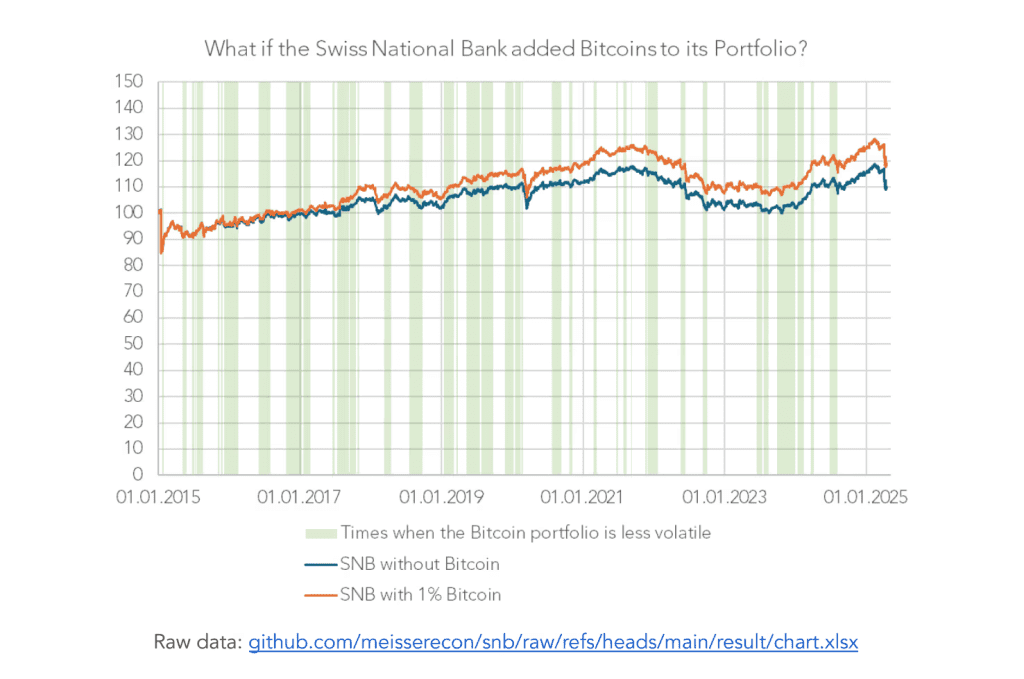
The BTC Initiative pushed back against the SNB position with a comprehensive study. If they had invested only 1% of the portfolio of the SNB from 2015, they would have almost doubled returns by 2024, based on their research. Volatility would have been only incrementally higher, their study indicated.
They contended that Bitcoin’s performance needs to be compared to other assets and not stand alone. Additionally, they highlighted that BTC continues to be one of the safest and most liquid digital assets in the world, even amid times of stress in markets. Against these arguments, Schlegel was adamant that risks outweigh the potential benefits for a central bank responsible for the financial security of a country.
Critics of the SNB’s move also suspect that political interests are at play. They say that high public holdings of BTC would cause diplomatic relations to deteriorate with European partners who are not friendly to cryptocurrency.
Indirect Bitcoin Exposure Through Corporate Investments
Although the SNB avoids direct ownership of Bitcoin, it is not completely out of touch with the crypto world. As an investor in large firms like Tesla, MARA Holdings, CleanSpark, and Strategy, the SNB is exposed to BTC indirectly.
These companies hold significant holdings of BTC on their balance sheets, thus linking to the BTC market. The SNB held millions of the companies’ shares at the end of 2024. However, Schlegel confirmed that these exposures are unintentional and not a deliberate BTC investment strategy.
Meanwhile, the SNB continues to explore digital innovations by experimenting on a central bank digital currency program aimed at developing financial institution payments. Central banks are divided all around the globe. While there are those such as America under Donald Trump that embrace strategic crypto holdings, Switzerland likes to proceed at its own time and prioritizes stability and not necessarily taking up cryptocurrencies hastily.
Related Reading: Is Bitcoin on Track for $100K? Key Indicators and Institutional Trends Point to Growth