Skip to content


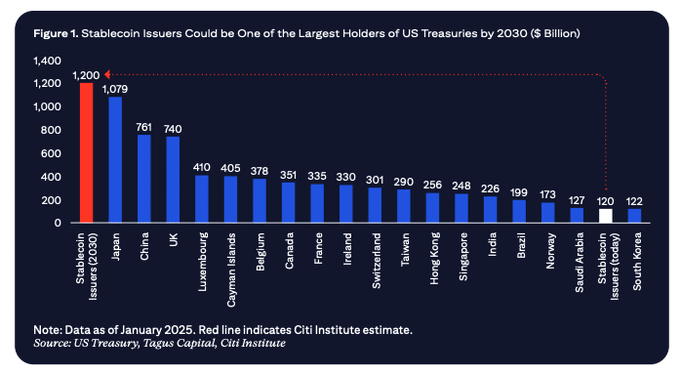
- Four stablecoin giants now hold more U.S. Treasuries than countries like South Korea and the UAE.
- Tether alone commands over $125 billion in short-term U.S. debt.
- A new Tether-Adecoagro deal explores bitcoin mining powered by renewable energy.
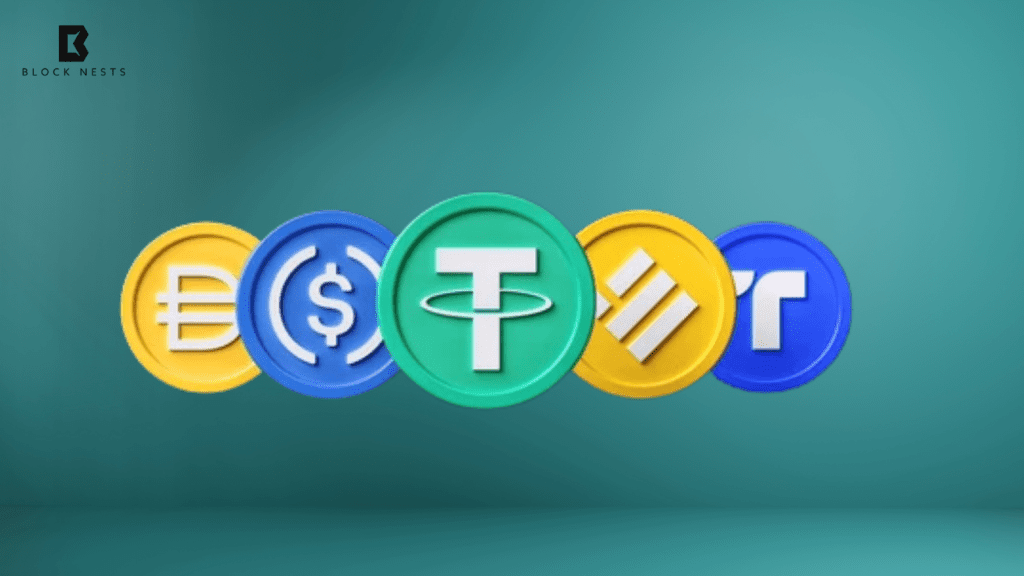
A powerful shift is unfolding in the digital asset sector. Four U.S. dollar stablecoin issuers, Tether, Circle, First Digital, and Paxos, now collectively control $182.4 billion in U.S. Treasury holdings. This figure exceeds the holdings of traditional nation-states like South Korea and the United Arab Emirates.
They are now ranked 17th globally, just behind Norway’s $195.9 billion, according to April statistics compiled by the United States Treasury Department. Tether leads the pack with over $125 billion of short-dated Treasuries, which leaves the company unfairly dominant in the United States debt market. Circle takes second place with a total of $55.2 billion, comprised of Treasury bills and overnight repo agreements.
First Digital and Paxos trail by $1.3 billion and $880 million, but their reserves are also based on government debt. Treasuries that are short-term have daily liquidity, settlement that is immediate, and stable returns above 5%. These are ideal reserve assets for stablecoins that need to guarantee prompt redemptions but don’t wish to rely on banks.
Stablecoins Create New Demand for Safe Assets
Stablecoin issuers’ growth in American debt markets heralds a new paradigm of finance. Stablecoin issuers are not regular banks, but their reserves are indicative of big-scale institutional appetite for safe assets. Tether alone cited over 80% of its reserves in Treasuries, repos, and Treasury-only funds, which earned a revenue of $1 billion during the first quarter of 2025.
A Circle strategy also includes leveraging BlackRock’s Circle Reserve Fund for added mobility. Paxos and First Digital, on a smaller scale, are also pursuing the same investment trajectories. These actions not only sustain liquidity but also establish routine government bond demand outside of traditional banking channels.
Regulators are catching up. United States draft regulations and EU draft regulations aim to write stablecoin reserve regulations into code. Both of these, the GENIUS Act and Europe’s MiCA regulation, look to limit collateral to cash and short-term Treasury notes. Both actions would put current stablecoin activities into compliance but also focus their dependence on Federal Reserve policy.
Tether Taps Renewable Energy for Bitcoin Mining
As part of thiseconomic boom, Tether is also expanding its horizons. On July 3, 2025, it signed a Memorandum of Understanding for South American leader in sustainable energy and agriculture, Adecoagro. Both will consider applying excess renewable energy to bitcoin mining.
This collaboration will stabilize energy prices and provide a secondary income stream by converting excess power into bitcoin. It accelerates decentralization and energy grid stabilisation, digitalizing assets as rural energy replacement instruments. Effective implementation will reframe the interface of renewable infrastructure to global finance.
In years to come, stablecoin issuers, including Tether and Circle, will keep growing and buy more U.S. Treasuries. This will make them even bigger players in global finance, contributing to increasing the size of the U.S. debt market and transforming money flows within the digital economy.
Related Reading: Bitcoin Reaches $108,850: Will It Continue to Surge?