Skip to content



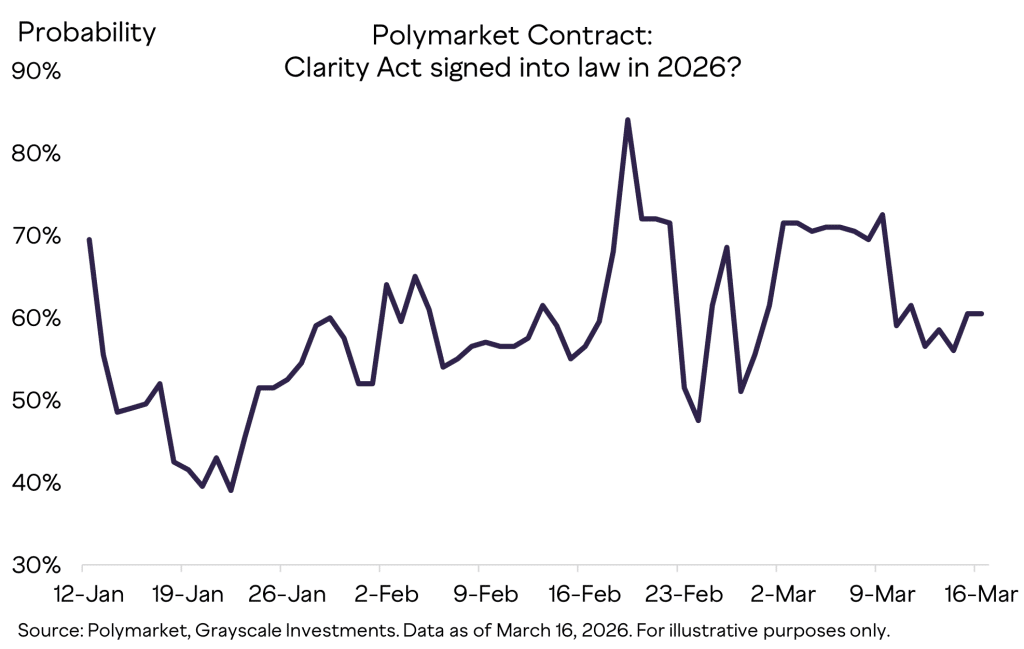
- The CLARITY Act faces a close Senate vote, with current odds near 50%.
- Banks and stablecoin issuers are competing over interest and transaction fees.
- Regulatory changes are reshaping the digital payments landscape.
The Senate is preparing to vote on the CLARITY Act in 2026. Market predictions put its chances at roughly 50%. Lawmakers and industry players are debating how banks and stablecoin issuers will operate side by side.
These discussions involve the issue of net interest margins and transaction fees, which are the two main sources of income for financial institutions such as banks. These sources of income are now being threatened by digital currencies. The financial institutions are concerned about the impact of stablecoins on their income.
The issuers of stablecoins see an opportunity to grow. The issuers of stablecoins argue that the platforms provide benefits such as faster payment systems and lower fees. This is one of the first major legislative battles between traditional and digital financial systems.
Stablecoins Compete With Traditional Banks
Digital payment systems derive revenue through two methods. The first is the net interest margin, or the difference between what banks earn from loans and what they must pay from deposits. The second is through transaction fee processing, where banks earn from consumers’ transactions.
Stablecoins also seek similar revenue streams. Circle and Tether issue digital dollars that attract interest for their holders, similar to bank deposits. However, blockchain networks such as Ethereum and Solana facilitate payments and earn from transactional fees. This challenges traditional revenue streams for banks.
Blockchain payments revolutionize traditional decades-long methods of doing things financially. Regulatory changes have created new avenues for crypto and banking competitions. The Genius Act of last year defined how digital currencies fit into financial laws. The Office of the Comptroller of the Currency (OCC) has started chartering crypto intermediaries as banks.
Fed Approves Kraken Account as Crypto and Banks Clash Over Rules
Recently, the Federal Reserve Bank of Kansas City greenlit Kraken’s limited account, which created a “skinny master account” for crypto transactions. This has created tension. Banks are advocating for tougher regulations in order to safeguard their earnings.
Crypto companies are advocating for regulations that support innovation in on-chain lending, decentralized exchanges, and blockchain technology. Discussions on stablecoins, interest rewards, and transaction fees are expected to go on for years.
The passing of the CLARITY Act will determine the nature of the relationship between traditional finance and blockchain technology in the future. This war is not for money only. It is for the determination of the kind of financial system America will have in the digital age.
Also Read: Strategy Continues Bitcoin Accumulation With 22,337 BTC Buy