Skip to content



- Visa launches Tempo validator node, taking direct role in stablecoin payments.
- Node built in-house over six months joins Stripe and Zodia Custody validators.
- Stablecoin market cap nears $319B as firms expand blockchain payment systems.
Visa has launched a validator node on the Tempo blockchain, marking a direct role in transaction processing and verification. The move places Visa within a network focused on real-time stablecoin payments and settlement infrastructure for global financial use.
The company said the node runs on its own infrastructure. Development took six months in coordination with Tempo engineers. Visa now operates as an anchor validator alongside early participants, including Stripe and Zodia Custody.
Visa Joins Validation Layer on Tempo Network
As a result of the decision, Visa becomes a participant in the validation layer in the network. This enables the ordering and validation of transactions within the network. Also, this function ensures security and network performance during the network’s initial period.
Tempo is a Layer 1 blockchain infrastructure designed specifically for real-time payments within the network. The main feature of Tempo blockchain technology is stablecoin transactions throughout the network.
Within the Tempo network, validators can receive rewards based on stablecoins. This happens when validators are approved to create and validate new blocks that will be added to the ledger.
This decision expands Visa’s blockchain activities since recently Visa became a participant in the Canton network as a validator. The network is engaged in privacy-focused on-chain systems operated by financial institutions.
Stablecoins continue to gain traction in global payments. Payment firms are expanding infrastructure tied to blockchain settlement. This shift reflects growing demand for faster and more efficient transaction systems.
Also Read: Aave DAO Grants $25M to Aave Labs After 75% Vote Approval
Stripe has also expanded its presence in the stablecoin sector. In October 2024, it finalized a $1.1 billion deal to acquire Bridge. The firm later introduced stablecoin accounts across more than 100 countries.
Stablecoin Payment Expansion Grows
These wallets allow the company to process transactions using US dollar stable coins. These wallets also enable keeping balances that can be compared to the balances maintained in conventional bank accounts. Moreover, it allows cross-border transfers with fewer delays.
Similar steps have been taken by Mastercard in the industry. Last month, it entered into an agreement for purchasing BVNK for up to $1.8 billion. The platform facilitates stable coin payments and currency conversions for over 130 countries.
On the other hand, Visa concentrated on developing its proprietary systems. In July, it announced its settlement services for PayPal USD and Euro Coin. This followed by integrating networks like Stellar and Avalanche.
In March, Visa partnered with Bridge to increase the number of countries participating in stable coin cards. Currently, there are 18 countries involved in the initiative. Visa aims to extend its services to over 100 countries by the end of the year.
DefiLlama data shows that stablecoin market capitalization had grown to almost $319 billion. It was up from around $307.5 billion at the beginning of the year.
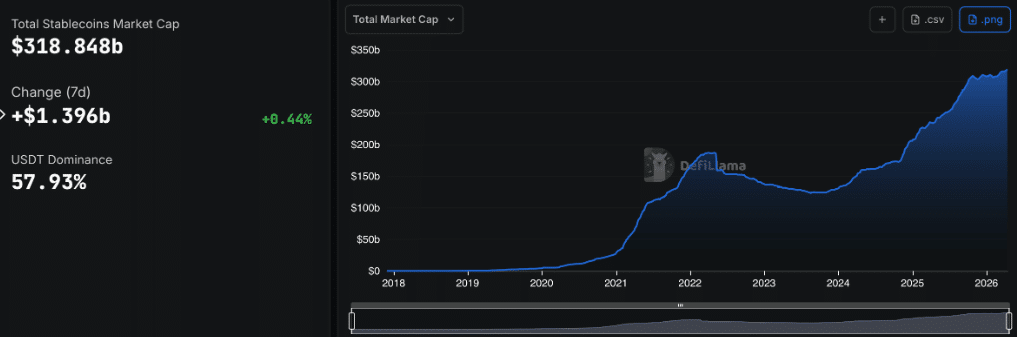
Source: DefiLlama
Also Read: Hedera Prepares for Quantum Threat as Blockchain Security Faces New Risks