Skip to content


- Solana adds Moody’s live on-chain ratings for tokenized fixed-income assets and funds.
- Moody’s TIE embeds credit data into token metadata with automatic updates on-chain.
- AlphaLedger supports Solana token issuance through its Vulcan Forge engine for RWAs.
Solana became the first major public, permissionless blockchain to host live Moody’s credit ratings on-chain. Moody’s Ratings deployed its Token Integration Engine on Solana mainnet through AlphaLedger. The platform focuses on tokenized institutional fixed-income assets under the new integration program.
The launch moves machine-readable credit data into token metadata. Wallets, smart contracts, and DeFi protocols can read the ratings without external checks. Moody’s said the system supports live updates when rating changes occur.
Also Read: CME Group to Sue CFTC Over Bitcoin Perpetual Futures Approval
Solana Mainnet Launch Follows Moody’s 2025 Devnet Test
The deployment follows a June 2025 proof-of-concept on Solana devnet. That test used a simulated municipal bond that was tokenized and rated. Its credit rating was then placed on-chain as part of the trial.
Moody’s later rolled out the Token Integration Engine on the Canton Network in March 2026. Canton is a permissioned blockchain built for institutional financial activity. The Solana launch extends the ratings tool to a major public network.
Moody’s Ratings reviews the underlying security through its independent credit methodology. The process produces standard grades used in fixed-income markets, including Aaa and Aa1. Those ratings are then prepared for tokenized asset records.
AlphaLedger handles issuance through its tokenization API platform. The system is powered by its Vulcan Forge engine. Issuers can add Moody’s ratings during issuance or after a fixed-income asset is tokenized.
Solana Supports Real-Time Credit Data for Tokenized Assets
The Token Integration Engine sends rating data and related metadata through secure APIs. The information is embedded into the asset’s token metadata on Solana. This links the credit signal to the token, not a separate off-chain file.
When Moody’s changes a rating, the update is reflected on-chain. That structure gives applications access to current credit data. It can support tokenized bonds, funds, and fixed-income instruments using programmable market infrastructure.
The integration also supports Solana’s push into institutional real-world assets. Tokenized asset value on the network has reached several billion dollars during recent growth. The network has also seen stablecoin, remittance, and asset-bridging activity.
The wider RWA market also continues to expand. Circle leads with about $7.3 billion, mainly through USDC, while Tether follows near $3.8 billion. BCG and Ripple project $18.9 trillion by 2033; McKinsey expects $2 trillion to $4 trillion by 2030, and Standard Chartered projects $30 trillion by 2034.
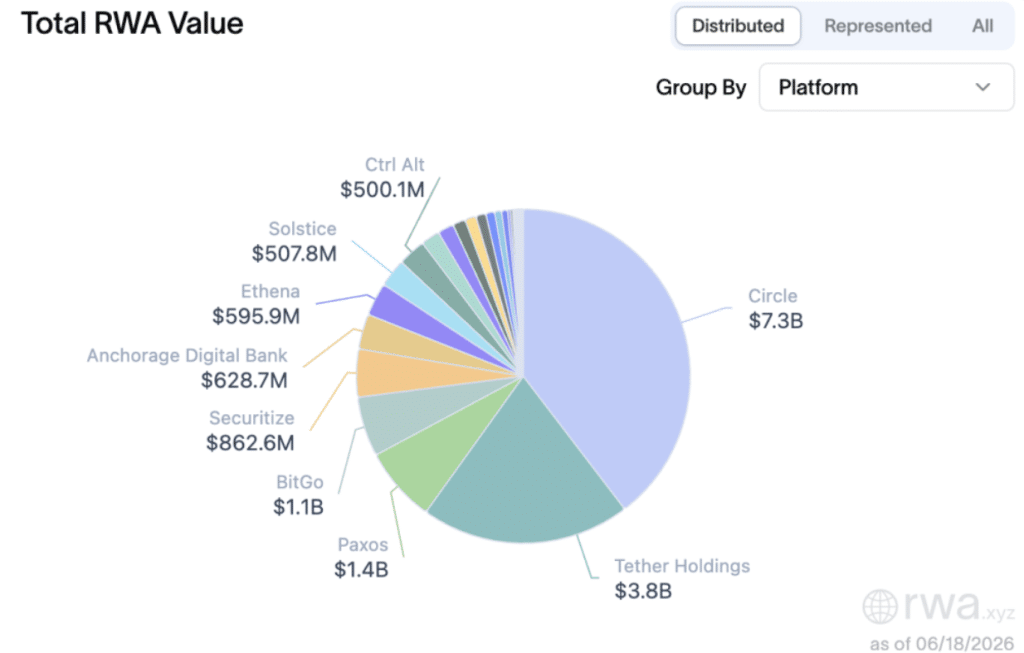
Source: RWA.xyz
Also Read: Crypto Valuation Is Changing: Why DeFi Revenue Models Matter More Than Ever